ai-memory
A persistent memory framework for AI coding assistants like Claude Code, Cursor, and Windsurf. Solves the problem of context loss across sessions: the agent forgets everything the moment you close the terminal.
Active development is paused. The repository remains public.
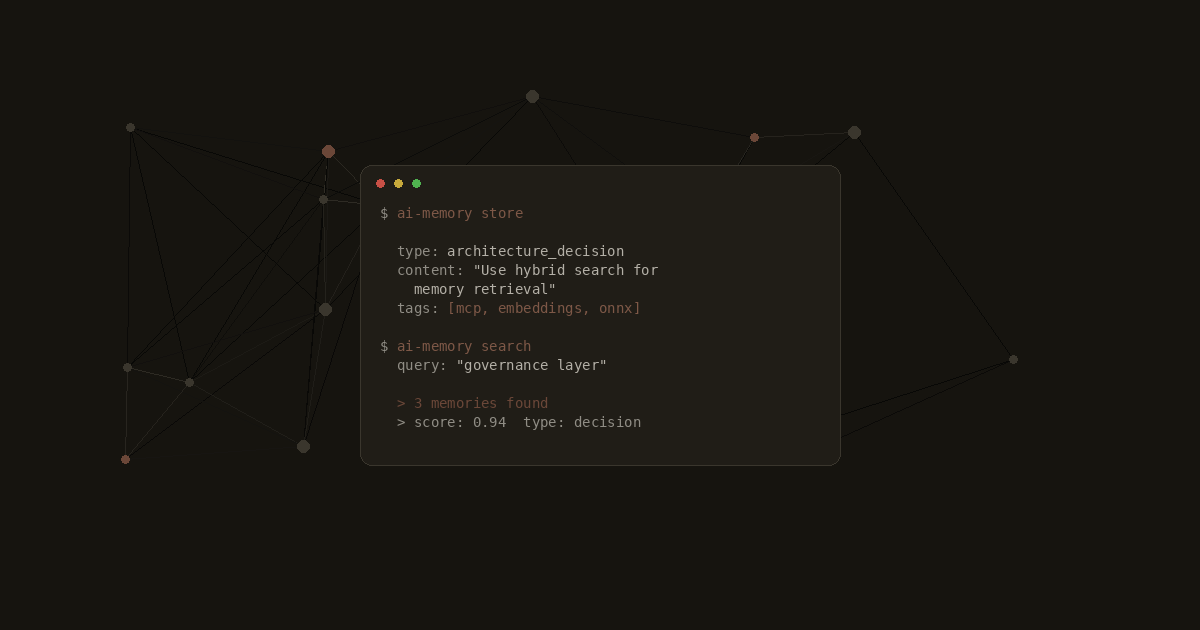
ai-memory ships as an MCP server with hybrid semantic and keyword search powered by local ONNX embeddings. It includes claim-based locking for multi-agent concurrency and a governance layer that compiles architectural decisions into enforceable code constraints.
The goal was simple: give AI assistants a memory that persists, searches well, and doesn’t need a cloud service. Everything runs locally.
I started ai-memory when persistent project-level memory was missing from most coding agents and I kept running into the same problem over and over again. After many chats with different coding agents, no matter the effort to keep documentation up to date, the context was gone and coding agents were making the same errors repeatedly and forgetting decisions that had already been made.
Since then, the landscape shifted: frontier AI products started shipping more memory and project-context features out of the box, projects like GBrain were created and open-sourced, and many others. Although these aren’t exact replacements for what I was building, and they don’t solve the memory problem entirely, they did narrow the gap considerably.
The original problem still matters, there's still a gap for certain use cases; however, maintaining another parallel system just didn’t feel like the best use of my time and the ROI didn't justify the effort anymore.
- Memory isn’t just storage, you need intentional capture, retrieval, forgetting and clear rules for what to keep and what to forget.
- Retrieval needs robust governance. Without it, search returns noise and agents trust (or save) the wrong context.
- Integration and maintenance are part of the product. The MCP server was the right approach then, but it was only one part of it. The database and consolidation of data are just as important and were missing the sophistication that projects like GBrain bring.
- Knowing when to pause is a product (and life) decision. Shipping isn’t always the right move. For someone wanting to push hard and move fast, knowing when to pivot become a key aspect of my day to day life. And it's now an ongoing test of whether I trust my intuition and my belief of the future.
Details
Solo · Open source · 2026